Article: Compare lab grown vs mined diamonds : which is better for your budget?
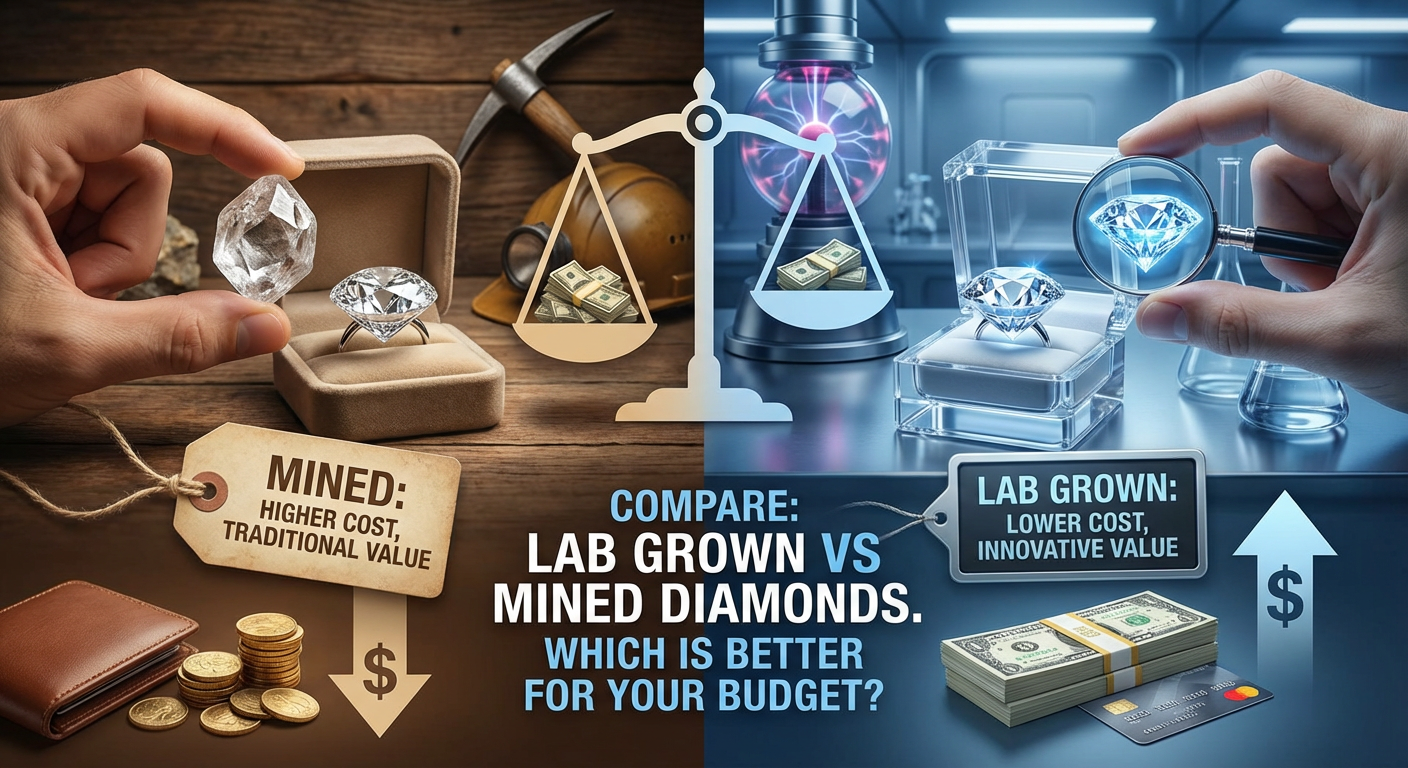
Compare lab grown vs mined diamonds : which is better for your budget?
Lab Grown vs Natural Diamonds:
Which Is Better for Your Budget in 2026?
――――――――――――――――――――
A complete, jargon-free guide for Indian buyers — covering price, quality, resale value, ethics, and the big question: is a lab diamond right for your family?
Updated: March 2026 | Reading Time: ~12 Minutes | Prices in INR
Quick Verdict: Know Before You Read On
Whether you are buying a solitaire engagement ring, a mangalsutra pendant, or an anniversary gift, the diamond market in 2026 looks very different from even five years ago. Here is what every Indian buyer needs to know upfront:
|
KEY TAKEAWAYS FOR INDIAN BUYERS (2026) Lab-grown diamonds cost 70–90% less than natural diamonds of identical quality. A 1-carat natural VS1 diamond costs approximately ₹3–7 lakh; the same lab-grown stone costs ₹65,000–1.8 lakh. Lab-grown diamonds are chemically, physically, and optically identical to mined stones — certified by the same IGI and GIA labs. Natural diamonds hold 25–45% resale value vs 10–25% for lab-grown — important for Indian families who treat jewellery as investment. Over 52% of engagement ring centre stones globally are now lab-grown (2024 data). In India, adoption is growing fast — especially in metros like Mumbai, Bengaluru, and Delhi. |
What Exactly Are Lab-Grown and Natural Diamonds?
Both are real diamonds. This is not a matter of debate — it is science and law. The Gemological Institute of America (GIA) and the International Gemological Institute (IGI) certify both using the same grading system.
Natural (Mined) Diamonds
Formed over 1–3 billion years, roughly 100 miles beneath the Earth's surface, under extreme pressure and heat. Brought to the surface through volcanic activity and then extracted through large-scale mining operations. They are finite in geological supply — which is one reason they carry such cultural and market weight.
Lab-Grown Diamonds
Created in controlled laboratory environments using two main processes:
• CVD (Chemical Vapour Deposition): A diamond 'seed' is placed in a chamber and carbon-rich gas is heated to create diamond growth layer by layer.
• HPHT (High Pressure High Temperature): Mimics the extreme conditions inside the Earth to crystallise carbon into diamond form.
The result? Diamonds that are chemically, physically, and optically identical to natural diamonds. They take 2–6 weeks to grow, not billions of years.
|
MYTH BUSTER Lab-grown diamonds are NOT 'fake' diamonds, cubic zirconia, moissanite, or crystal. They are not 'simulants'. They are real diamonds — just grown above ground instead of below it. |
Price Comparison: The Numbers That Will Surprise You
This is where Indian buyers typically experience the greatest surprise — and where the case for lab-grown diamonds is strongest.
Lab-Grown vs. Natural Diamond Prices in India (2026)
The following prices are indicative retail ranges in INR. Actual prices vary by cut quality, shape, exact grading, and the jeweller's margin:
|
Diamond Spec |
Lab-Grown Price (INR) |
Natural Diamond Price (INR) |
Your Savings |
|
0.50 ct · VS1 · Excellent |
₹20,000 – ₹55,000 |
₹80,000 – ₹1,60,000 |
~65–75% |
|
1 ct · VS1 · Excellent |
₹65,000 – ₹1,80,000 |
₹3,00,000 – ₹7,00,000 |
~70–80% |
|
1.5 ct · VS2 · Excellent |
₹1,00,000 – ₹2,50,000 |
₹7,00,000 – ₹15,00,000 |
~80–85% |
|
2 ct · VS1 · Excellent |
₹1,40,000 – ₹2,80,000 |
₹15,00,000 – ₹30,00,000 |
~85–90% |
|
3 ct · VS2 · Excellent |
₹2,50,000 – ₹5,00,000 |
₹50,00,000+ |
~90–94% |
To put this in perspective: with the budget of a 1-carat natural diamond, you could buy a 2.5-carat lab-grown diamond — same sparkle, significantly larger presence on the finger.
Why Have Lab Diamond Prices Fallen So Sharply?
• Better technology: CVD and HPHT production has become far more efficient, cutting manufacturing costs.
• Global competition: More lab diamond producers globally — including growing capacity in India — have created pricing competition.
• No scarcity: Unlike mined diamonds, lab diamonds can be produced on demand, eliminating artificial rarity.
• Indian production: India, already the world's largest diamond cutting and polishing hub (Surat processes ~90% of the world's diamonds), is now also scaling lab diamond production, reducing import costs.
|
SURAT ADVANTAGE India's diamond cutting industry — centred in Surat, Gujarat — is now one of the world's fastest-growing lab diamond manufacturing and processing hubs. This is helping reduce the retail price of lab-grown diamonds in India faster than in most other markets. |
Quality & Appearance: Can Anyone Tell the Difference?
The short answer: No. Not with the naked eye. Not even most trained jewellers without specialised equipment.
The 4Cs Apply to Both
Both lab-grown and natural diamonds are graded on the same standard:
• Cut: Determines sparkle and brilliance — the most important C.
• Color: Graded D (colourless) to Z (yellow tint).
• Clarity: Measures internal inclusions and surface blemishes.
• Carat: Weight of the diamond.
Lab-grown diamonds often achieve higher colour and clarity grades at lower price points — because controlled growth produces fewer impurities.
What Only Instruments Can Detect
Gemologists using UV fluorescence spectroscopy, photoluminescence testing, and specialised magnification can identify lab-grown diamonds by subtle growth patterns. Standard jewellers and family members cannot. Both GIA and IGI now certify lab-grown diamonds with laser-inscribed girdle markings to disclose their origin — so there is full transparency in the formal jewellery market.
Resale Value: The Most Important Factor for Indian Families
In Indian culture, jewellery has traditionally served a dual purpose: adornment and financial security. Diamonds — especially those set in gold — have been passed down as family assets and pledged during emergencies. This context makes resale value uniquely critical for Indian buyers.
The Honest Picture
Natural Diamonds
• Resale value: approximately 25–45% of purchase price
• Stable long-term pricing due to geological scarcity
• Better accepted by traditional jewellers for exchange / buy-back schemes
• Tanishq, Malabar Gold, and major jewellers run buy-back programmes for certified natural diamonds
Lab-Grown Diamonds
• Resale value: approximately 10–25% of purchase price
• Prices have fallen ~74% since 2020 — older purchases may fetch even less as newer stones are cheaper
• Growing but still limited buy-back market in India in 2026
• Best treated as a 'wear and love' purchase, not a financial investment
|
THE NET COST CALCULATION Even with lower resale, lab-grown diamonds are often far cheaper in real terms. Example: A 1-carat natural diamond at ₹5,00,000 with 35% resale = net cost ₹3,25,000. A comparable lab-grown at ₹1,20,000 with 20% resale = net cost ₹96,000. The lab-grown option is still 70% less expensive in real terms. |
However, for families who genuinely intend to pass a diamond down as a family heirloom or use it as a financial safety net, natural diamonds remain the more prudent choice.
The Indian Context: Cultural, Religious, and Auspicious Considerations
Diamonds occupy a special place in Indian jewellery traditions. From polki and Kundan jewellery to contemporary solitaire rings, the diamond carries deep aesthetic and cultural weight. Here is how lab-grown diamonds fit into India's jewellery ecosystem:
Mangalsutra & Wedding Jewellery
Lab-grown diamonds are increasingly popular for mangalsutra pendants, since the priority is beauty and daily wearability, not long-term investment. The cost savings allow brides to choose larger or more intricately designed pieces within the same budget.
Engagement Rings
The Western concept of diamond solitaire engagement rings is growing rapidly in India, especially among urban, younger couples. For this category, lab-grown diamonds offer the most value — because the emotional significance comes from the gesture, not the geological origin.
Investment Jewellery
For traditional diamond jewellery bought with investment intent — or pieces that will be part of a daughter's streedhan — natural diamonds remain the conventional choice. Established jewellers across India predominantly value and buy back natural diamonds.
Gift Giving
For anniversary gifts, milestone gifts, or daily-wear jewellery, lab-grown diamonds offer outstanding value. The recipient gets a visually identical, certified diamond — often significantly larger than would be possible with the same budget for a natural stone.
Side-by-Side Comparison: Lab-Grown vs. Natural Diamonds
|
Category |
Lab-Grown Diamond |
Natural Mined Diamond |
|
Price (1 ct) |
₹65K – ₹1.8L |
₹3L – ₹7L |
|
Chemical Composition |
Pure Carbon (identical) |
Pure Carbon (identical) |
|
Hardness (Mohs) |
10 (same) |
10 (same) |
|
Visual Difference |
None to naked eye |
None to naked eye |
|
IGI/GIA Certified |
Yes |
Yes |
|
Resale Value |
10–25% of purchase |
25–45% of purchase |
|
Environmental Impact |
Lower (less mining) |
Significant land use |
|
Ethical Sourcing |
No conflict risk |
Varies by origin |
|
Rarity / Exclusivity |
Mass-producible |
Geologically finite |
|
Family / Tradition |
Newer concept |
Strong cultural weight |
|
Mangalsutra/Jewellery |
Excellent value choice |
Traditional preference |
Ethics & Environment: Does Origin Matter?
For a growing segment of buyers — particularly younger, urban Indians — the ethical story behind a purchase matters.
Lab-Grown Diamonds
• No land displacement or open-cast mining
• No risk of conflict or 'blood diamond' sourcing
• Lower land and water disruption per stone
• Energy use varies by facility — renewable-powered labs have the smallest footprint
Natural Diamonds
• The Kimberley Process Certification Scheme (KPCS) monitors conflict diamond trade, though enforcement is imperfect
• Certified ethical mining programmes exist, including Fairtrade-certified mines
• Mining provides livelihoods for millions in countries like Botswana, South Africa, and India's own mining communities
• Significant land use, water consumption, and carbon footprint per stone
|
INDIA NOTE India is the world's largest importer of rough diamonds and processes roughly 90% of the world's cut and polished diamonds. The diamond industry supports over 7 lakh workers in Surat alone. Both natural and lab-grown diamonds flow through Indian hands — supporting the same skilled workforce. |
Who Should Choose What? A Decision Guide for Indian Buyers
Choose Lab-Grown If You...
• Want maximum carat size and visual impact within your budget
• Are buying for daily wear — mangalsutra, rings, everyday pendants
• Are a younger couple prioritising design and beauty over resale
• Are buying a gift and want a certified, beautiful diamond at a fair price
• Care about ethical sourcing and environmental footprint
• Do not intend to resell or use the diamond as a financial asset
Choose Natural Diamond If You...
• Are buying as part of family streedhan or long-term investment jewellery
• Value rarity, provenance, and geological heritage
• Are purchasing for a traditional family where diamond jewellery is treated as a financial asset
• Want access to established buy-back and exchange programmes at major jewellers
• Are buying a particularly large stone (3 ct+) where mined rarity has cultural and market weight
Smart Buying Tips for Indian Consumers in 2026
Always Ask for Certification
Insist on a GIA or IGI certificate for any diamond purchase — lab-grown or natural. Both will clearly state the diamond's origin, grade, and specifications. Uncertified diamonds carry significant risk.
Understand the GST Implications
In India, both lab-grown and natural diamonds attract GST. Lab-grown diamonds have seen GST reclassification discussions — verify current rates with your jeweller, as this affects final pricing.
Compare Within Budget, Not Just Category
Rather than asking 'should I buy lab or natural?', ask: 'what is the best certified diamond I can get for my exact budget?' Lab-grown almost always wins on size and grade at any given price point.
Buy from Reputable Jewellers
Established jewellers — Tanishq, Malabar Gold, Kalyan Jewellers, CaratLane, and similar trusted brands — offer certified lab-grown and natural diamonds with clear disclosure. Avoid uncertified loose diamonds from unverified sources.
Factor in the Setting
The gold or platinum setting significantly affects total cost. A well-cut 1.5-carat lab-grown diamond in a well-designed 18K gold solitaire will often look more impressive — and cost less — than a 0.5-carat natural stone in a comparable setting.
Frequently Asked Questions
Are lab-grown diamonds real diamonds?
Yes. Chemically and physically identical to mined diamonds. Certified by GIA and IGI using the same 4Cs grading system. The US FTC formally recognised lab-grown diamonds as real diamonds in 2018.
Can Indian jewellers tell the difference?
Not with standard equipment. Specialised gemological instruments are required. Your family members, friends, and standard jewellers cannot tell lab-grown from natural by sight or touch.
What about resale at traditional Indian jewellers?
Resale of lab-grown diamonds remains limited at many traditional jewellers. This is changing, but for now, natural diamonds have a far more established buy-back ecosystem in India. If resale matters, choose natural.
Are lab-grown diamonds available in India?
Yes — widely available. Tanishq, CaratLane, BlueStone, Malabar Gold, and many independent jewellers across metro cities offer IGI-certified lab-grown diamonds. Availability in Tier 2 cities is growing.
Do lab-grown diamonds lose colour or sparkle over time?
No. A lab-grown diamond is a real diamond — it will not cloud, yellow, or lose brilliance over time. It is as durable as any natural diamond.
Are there any GST benefits for lab-grown diamonds?
GST rates on lab-grown and natural diamonds have been subject to revision. As of 2026, lab-grown diamonds attract a different GST treatment than rough natural diamonds but similar rates on cut and polished stones — consult a certified jeweller for the most current tax implications.
Conclusion: The Diamond That's Right for You
In 2026, the question is no longer 'Are lab-grown diamonds real?' — they are, unambiguously. The real question is what you want a diamond to do for you.
If you want maximum beauty, size, and value for your money — and plan to wear and love your diamond forever — a lab-grown diamond is a remarkable choice.
If you want a diamond that functions as a family asset, integrates with traditional buy-back schemes, and carries the cultural weight of geological rarity — a natural diamond remains the right call.
Both are real. Both are beautiful. Both are diamonds. The right one is whichever aligns with your priorities, your family's values, and your budget.
|
DISCLAIMER All prices quoted are indicative retail ranges in INR as of Q1 2026. Actual prices may vary based on specific diamond grades, jeweller margins, GST rates, and market conditions. Always verify prices with certified jewellers and insist on GIA or IGI certification for any diamond purchase. |