Article: Moissanite vs Lab Grown Diamonds: What's the Difference? (2026 Guide)
Moissanite vs Lab Grown Diamonds: What's the Difference? (2026 Guide)
Shopping for a ring but confused between moissanite and lab grown diamonds? You are not alone. Both stones look almost the same to the naked eye. Both are made in a lab. And both cost much less than a mined diamond. But they are very different and choosing the wrong one could leave you disappointed later.
In this simple, honest guide, we explain exactly what each stone is, how they compare on sparkle, price, durability, and which one is right for you. No confusing terms. No sales pitch. Just clear facts.

What Is Moissanite?
Moissanite is a gemstone that looks a lot like a diamond — but it is not a diamond.
It was first discovered in 1893 by French scientist Henri Moissan inside a meteor crater in Arizona. He thought he had found diamonds! But the stone turned out to be made of silicon carbide, a completely different material from diamond.
Natural moissanite is extremely rare. So today, almost all moissanite sold in jewellery shops is made in a laboratory. It is affordable, sparkly, and ethical (no mining involved). But it is what jewellers call a "diamond simulant" — a stone that looks like a diamond but is not one.
Simple answer: Moissanite looks like a diamond but is a different stone entirely.
What Is a Lab Grown Diamond?
A lab grown diamond is a real diamond — just made in a factory instead of dug out of the ground.
It has the exact same chemical makeup as a natural diamond: pure carbon. It is graded by the same labs (GIA and IGI) using the same 4C system — Cut, Colour, Clarity, and Carat. Even expert gemologists cannot tell a lab grown diamond apart from a mined one without special equipment.
Two methods are used to grow them:
- HPHT (High Pressure, High Temperature) – recreates the extreme heat and pressure found deep underground.
-
CVD (Chemical Vapor Deposition) – grows diamonds layer by layer from a carbon gas in a chamber.
Because they are made in a lab, they cost 40–70% less than mined diamonds — while being identical in every way that matters.
Simple answer: A lab grown diamond is 100% real. It is just grown in a lab, not the earth.

Moissanite vs Lab Grown Diamond — Side by Side
|
Feature |
Moissanite |
Lab Grown Diamond |
|
What it's made of |
Silicon carbide |
Pure carbon (same as diamonds) |
|
Is it a real diamond? |
No |
Yes |
|
Hardness (Mohs scale) |
9.25 / 10 |
10 / 10 |
|
Sparkle type |
Colourful rainbow flashes |
Classic white sparkle |
|
Certified by GIA / IGI? |
No |
Yes |
|
Price (1 carat) |
$300–$600 |
$800–$1,500 |
|
Resale value |
Very low |
20–40% of purchase price |
|
Ethical / no mining? |
✅ Yes |
✅ Yes |
1. The Biggest Difference — What They're Made Of
This is the most important thing to understand.
Lab grown diamonds are made of carbon — the exact same material as the diamonds your grandparents wore. They are real, certified diamonds in every sense of the word.
Moissanite is made of silicon carbide — a completely different material. It is not a diamond. It is its own unique gemstone.
Why does this matter? Because if someone asks "is that a real diamond?" — a lab grown diamond owner can say yes. A moissanite owner cannot. For some people, that matters a lot. For others, it doesn't matter at all.
2. Sparkle — Which One Looks Better?
Both stones sparkle beautifully. But they sparkle differently.
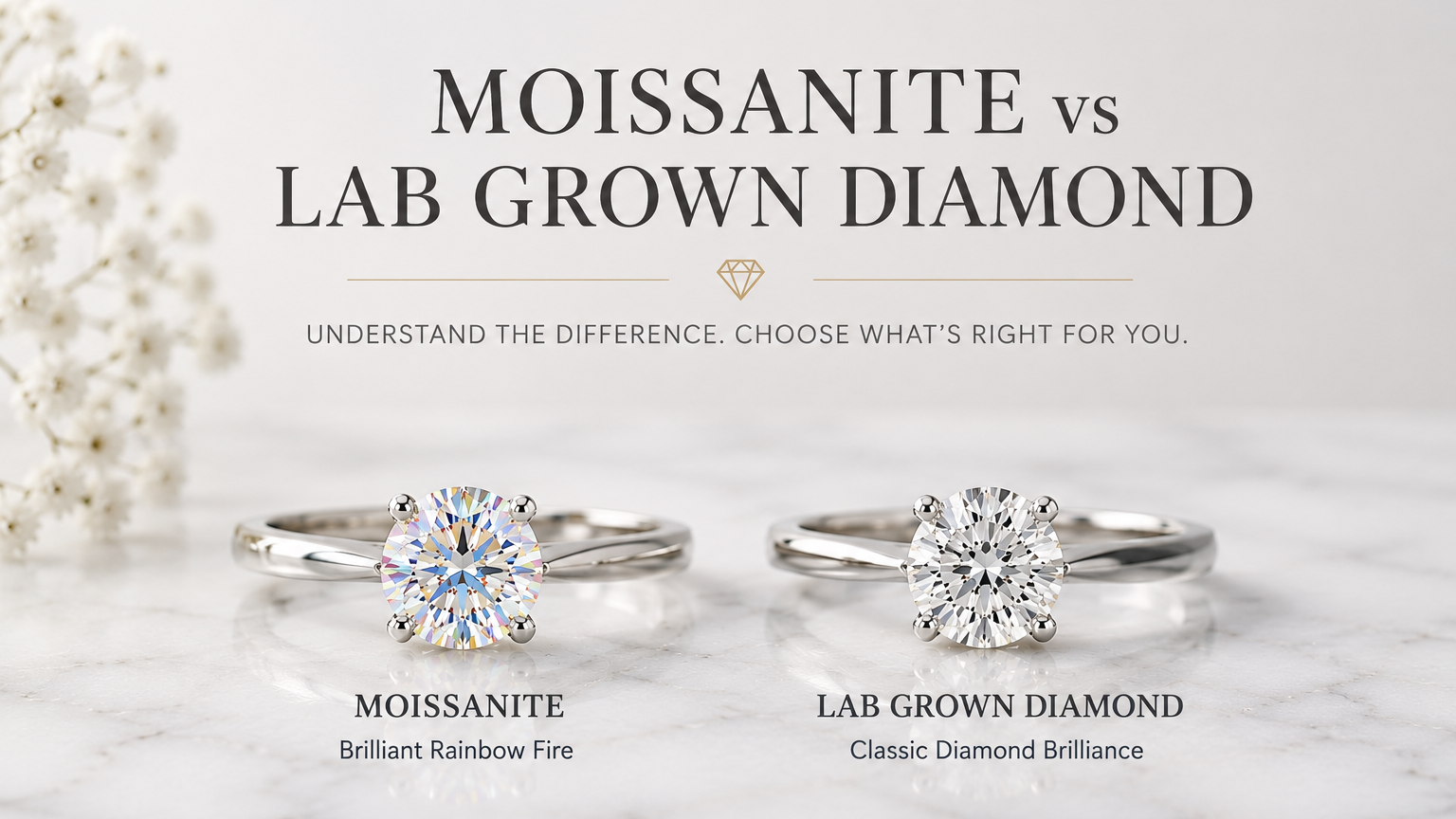
Moissanite bends light more strongly than diamonds. This gives it a bold, colourful fire — rainbow flashes that catch the eye in sunlight. Some people love this look. Others find it looks "too sparkly" or "not quite like a diamond."
Lab grown diamonds give off the classic white brilliance that people have always associated with diamonds. It is more subtle, more elegant, and looks exactly like what most people picture when they think of a diamond ring.
Neither is wrong — it is just a matter of personal taste:
-
✨ You love colourful, bold sparkle? → Go for moissanite
-
💎 You love classic, clean diamond sparkle? → Go for a lab grown diamond
One thing to note: the rainbow effect of moissanite becomes more noticeable the larger the stone. In a 2–3 carat stone, some people find it beautiful. Others find it a little too flashy.
3. Durability — Will It Last a Lifetime?
Good news — both stones are very durable and perfect for everyday wear, including engagement rings.
Jewellers measure hardness on the Mohs scale (1 = softest, 10 = hardest):
-
Lab grown diamond: 10/10 — the hardest material known to exist
-
Moissanite: 9.25/10 — the second hardest gemstone used in jewellery
Both will survive daily wear without scratching. But if you are buying a ring to wear every day for the next 50 years, a lab grown diamond has a slight advantage — its surface stays in perfect condition a little longer over time.

4. Colour — Do They Look Colourless?
Lab grown diamonds are graded from D (perfectly colourless) to Z (slightly yellow). You choose the exact colour grade you want, just like a mined diamond.
Moissanite appears colourless to most people. But under certain lighting, especially larger stones, it can show a faint yellow or green tint. High-quality moissanite has improved a lot in recent years, but this is still worth keeping in mind if you want a perfectly icy white look.

5. Price — The Number That Surprises Most Buyers
This is where moissanite has a clear, undeniable advantage.
Here is how the prices compare in 2026:
|
Stone Size |
Moissanite |
Lab Grown Diamond |
|
1 carat |
₹28,000–₹57,000 |
₹76,000–₹1,42,000 |
|
2 carat |
₹66,000–₹1,23,000 |
₹1,70,000–₹3,31,000 |
|
3 carat |
Under ₹95,000 |
₹2,84,000–₹5,67,000+ |
Moissanite typically costs 50–70% less than a comparable lab grown diamond. In simple terms, you can get a 2-carat moissanite for roughly the same price as a 1-carat lab grown diamond.
It is also worth knowing that lab grown diamond prices have fallen by 40–60% since 2021. This means the gap between moissanite and lab diamonds is smaller than it used to be — which makes lab diamonds a better deal now than ever before.
6. Resale Value
If you ever plan to sell or upgrade your ring, this matters.
-
Lab grown diamonds hold about 60–80% of their purchase price on the resale market
-
Moissanite holds very little resale value
Most people buy jewellery to wear and love — not to resell. But if there is any chance you might upgrade later, a lab grown diamond gives you more flexibility.
7. Are They Both Ethical?
Yes — both are excellent choices if you care about ethical sourcing.
Neither requires mining. There are no conflict concerns. And both have a much smaller environmental footprint than mined diamonds.
However, how "green" they are depends on the manufacturer. Some lab grown diamond producers run on renewable energy. Moissanite factories also vary. If sustainability is very important to you, look into the specific brand's energy practices before buying.
8. One Big Update for 2026 — Moissanite Market News
Here is something important that most guides do not mention:
Charles & Colvard, the company that invented gem-quality moissanite and is the biggest name in the industry, filed for bankruptcy in March 2026. This raises questions about the long-term availability of their products and after-sales support.
This does not mean moissanite is disappearing. Other manufacturers still make it. But it is worth keeping in mind when making a long-term purchase like an engagement ring.
So Which One Should You Choose?
Here is a simple way to decide:
✅ Choose Moissanite if…
-
Budget is your top priority
-
You want the biggest stone for your money
-
You love bold, colourful sparkle
-
You are buying fashion jewellery (not a lifelong engagement ring)
-
You are comfortable with it not being a "real diamond"
💎 Choose a Lab Grown Diamond if…
-
You want a real, certified diamond
-
Classic white sparkle matters to you
-
You might want to resell or upgrade in future
-
You are buying an engagement ring meant to last a lifetime
-
The slightly higher price fits your budget
For most people shopping for an engagement ring at the 1–2 carat range, lab grown diamonds now offer very strong value — especially since prices have dropped so much. At 3+ carats, moissanite's price advantage becomes harder to ignore.
Quick Summary
-
Moissanite is not a diamond — it is silicon carbide, a different material
-
Lab grown diamonds are real diamonds — same carbon, same grading, same sparkle
-
Moissanite sparkles with colourful fire; lab grown diamonds have classic white brilliance
-
Both are very durable and ethical choices
-
Moissanite is 50–70% cheaper — a great option if budget is tight
-
Lab grown diamonds have better resale value and feel more "official"
There is no wrong answer here. The best stone is the one that makes you smile every time you look at it. Now you have all the facts to choose with confidence.
Still not sure which stone is right for you? Leave your question in the comments — we are happy to help.
Related Articles:
-
How Much Does a Lab Grown Diamond Cost in 2026?
-
Lab Grown vs Mined Diamonds: Is There Actually a Difference?
-
Engagement Ring Buying Guide: Understanding the 4Cs
-
Best Engagement Rings Under $2,000 in 2026