

Diamond Education
Diamond shapes for engagement rings: six options to compare
Compare six diamond shapes and consider their outline, proportions and setting requirements when choosing an engagement ring.

On this page
Choose a diamond shape by comparing its outline, proportions and appearance in the setting you want. This guide covers six options for an engagement ring, whether you are considering a lab-grown or natural diamond.
Shape and cut quality describe different things
Shape describes the outline. Cut also concerns how a diamond has been fashioned, including facet arrangement, proportions and finish. A shape name alone does not guarantee sparkle, visible size or price.
Six engagement-ring shapes to compare
Round brilliant: a circular outline
A round brilliant combines a circular outline with brilliant-style faceting. Compare its proportions, finish and light performance in the actual stone rather than assuming every round diamond looks the same.

Oval: length and proportion
An oval offers an elongated outline. Compare length-to-width proportions and any visible dark bow-tie pattern in different lighting. Two ovals of the same weight can look noticeably different.

Princess: a square outline with corners
A princess cut offers a square outline and pointed corners. Ask how the setting protects those corners, and compare the diamond’s appearance and the ring’s height.

Cushion: rounded corners
A cushion combines rounded corners with a square or rectangular outline. Facet patterns vary, so compare actual examples if you prefer a particular style of sparkle.

Emerald: step-cut facets
An emerald cut has a rectangular outline, cut corners and step-cut facets. Compare the pattern of reflections, proportions and any visible inclusions in the actual stone.

Marquise: an elongated pointed outline
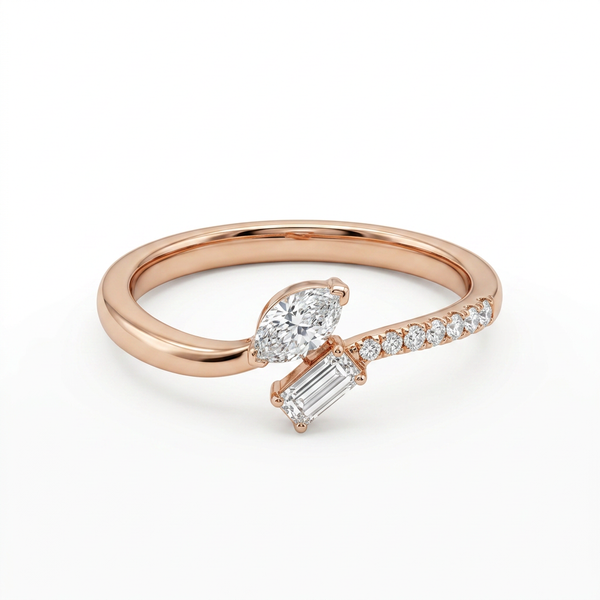
A marquise has an elongated outline with two pointed ends. Check its symmetry and proportions, and ask how the setting protects the tips and feels on the hand.

Compare the diamond on the hand
Check actual millimetre dimensions alongside carat weight. Compare band width, setting height and how the ring sits with a wedding band. Try more than one outline before choosing; an elongated shape is a preference, rather than a rule about what suits a particular hand.
Confirm the stone and setting details
Ask which independent report applies to the selected diamond or finished jewellery. Compare complete quotations including the stone, additional diamonds, metal, making charges and taxes.
Explore Glora’s engagement rings or discuss a custom setting. Confirm design feasibility, size, timing and applicable aftercare before approving the order.
Share
Keep exploring
A little more to discover

Diamond dimensions in millimetres: look beyond carat weight
Two diamonds of the same carat weight can look different in size. Compare actual dimensions, shape and proportions alongside weight and appearance.

Choosing an engagement ring in 2026: a practical checklist
Set a comfortable budget, compare shapes and settings, and confirm the diamond report, hallmark, ring size and written terms before ordering.

VVS Clarity and E–F Colour: An Engagement Ring Guide
Understand what VVS clarity and E–F colour describe, then compare appearance, cut, setting, documentation and price before choosing your ring.
A little guidance from Glora
Compare rings beyond the first photograph
Diamond shapes for engagement rings: six options to compare
Use these details to narrow down the rings you are considering.
Ring size & band width Open to explore
Check the ring-size system and the width of the band. A wider band can feel different from a slim one; ask for help confirming the size for the design you choose.
Setting height & side profile Open to explore
Look at the side view as well as the top view. Consider how high the setting sits and how it might fit beside another ring.
Centre stone or total weight? Open to explore
Check whether the stated carat weight describes the centre stone or all diamonds in the ring. Compare the stated dimensions when judging its outline.
Illustrations explain what to compare; they do not represent a particular product or its dimensions.
Explore Lab-Grown Diamond Engagement Rings
A starting point for your shortlist. Open a piece for its current options, price and details.


Round Brilliant Lab Grown Diamond Classic Solitaire Ring
Sale priceRs. 46,521.00